
The Tariff Test: What’s at stake for Nordic CEOs in 2025
- Insights

- 25. Mai 2025
- 6 Min. Lesezeit
Trade policy volatility has ushered in persistent uncertainty, forcing Nordic companies – like peers elsewhere – to shift from merely deferring decisions to actively managing risk. Even in the small, export-driven economies of Norway, Denmark, Sweden and Finland, the direct impact of any one tariff shock may be modest, but the knock-on effects – currency swings, delayed investments, and shaken consumer confidence – can ripple broadly.

With inventory buffers dwindling and shareholders demanding delivery, leaders must move beyond “wait and see.” This article presents a structured roadmap for CEOs to allocate capital smartly under geopolitical risk, fortify supply chains, build in-house trade intelligence, adjust pricing and cost management, and engage in trade policy. The goal: transform uncertainty into an advantage, ensuring Nordic firms stay growth‑focused amid global tariffs.
Key Facts
Global growth is slowing. World GDP is projected below 3% in 2025–26 as trade tensions and weak investment curb demand.
Major new U.S. tariffs. Early 2025 saw 25% duties on imported steel and aluminium and new levies on imports (including 10% on Chinese goods), with low-value exemptions ending.
Nordic export reliance. Scandinavian economies are highly trade-dependent (exports often exceed 50% of GDP); many firms span both U.S. and EU markets, making them sensitive to transatlantic trade shifts.
Complex supply chains. A tariff on imported inputs can cascade through multiple value-chain tiers, raising costs by more than the headline rate.
High investor scrutiny. Surveys suggest over 80% of shareholders expect companies to meet current-year targets, leaving little slack for delay or profit shortfalls.
Strategic Takeaways
Stress-test and price for every scenario. Quantify tariff impacts on costs and profits, and incorporate tariff-adjustment clauses or clear pricing triggers in contracts to preserve margins.
Diversify and buffer supply chains. Secure multiple sourcing options (including EU/EFTA and other global markets) and build strategic inventory buffers. Lock in long-term deals with an array of suppliers to avoid single-source risk.
Build a trade-compliance center. Establish a cross-functional team or “tariff war room” to monitor policy changes, decode complex regulations, and reroute logistics in real time.
Allocate capital flexibly. Prioritize investments in resilience (automation, local manufacturing, R&D) and maintain optionality in spending. Scale back or defer projects with high tariff exposure.
Act decisively, communicate clearly. Initiate “low-regret” moves now (e.g. alternative suppliers, scenario drills) and keep stakeholders informed. Engaging with policymakers and industry peers can help shape more favorable trade outcomes.
The shifting trade landscape
Over the past few years, rising geopolitical tensions have injected uncertainty into global trade flows. For Nordic CEOs, this plays out through both external and local channels. The Nordics’ open economies rely heavily on exports and imported inputs. Sweden’s advanced manufacturing, Finland’s tech sector, Denmark’s life‑sciences and shipping industries, and Norway’s energy sector all connect to global value chains. While none of these countries alone dominate a massive bilateral imbalance with the US or China, indirect effects loom large: higher tariffs abroad can slow demand for Nordic exports, drive up costs for imported components, and even weaken the Scandinavian risk-off scenarios.
GLOBAL DISRUPTORS

Local Economic Exposure
 |  |  |  |
Life-Sciences & Shipping Industries | Energy Sector | Advanced Manufactoring | Tech Sector |
Many Nordic companies took a cautious stance when new tariffs were announced – freezing large investment decisions, pausing deal-making and hoarding inventory. That “time‑out” was prudent initially, giving businesses time to assess the fallout. But with stockpiles running down and forward sales dates approaching, passive delay is becoming risky. European observers note that small open economies suffer more from tariff uncertainty, even if the immediate GDP hit is low.
Consumers and managers in the Nordics face volatility in material costs and export planning, and financial markets expect leaders to maintain growth trajectories despite policy noise. In short, shareholders will give no quarter to CEOs who let indecision slow progress.
Source: Friis+Børgesen Analytics; BCG
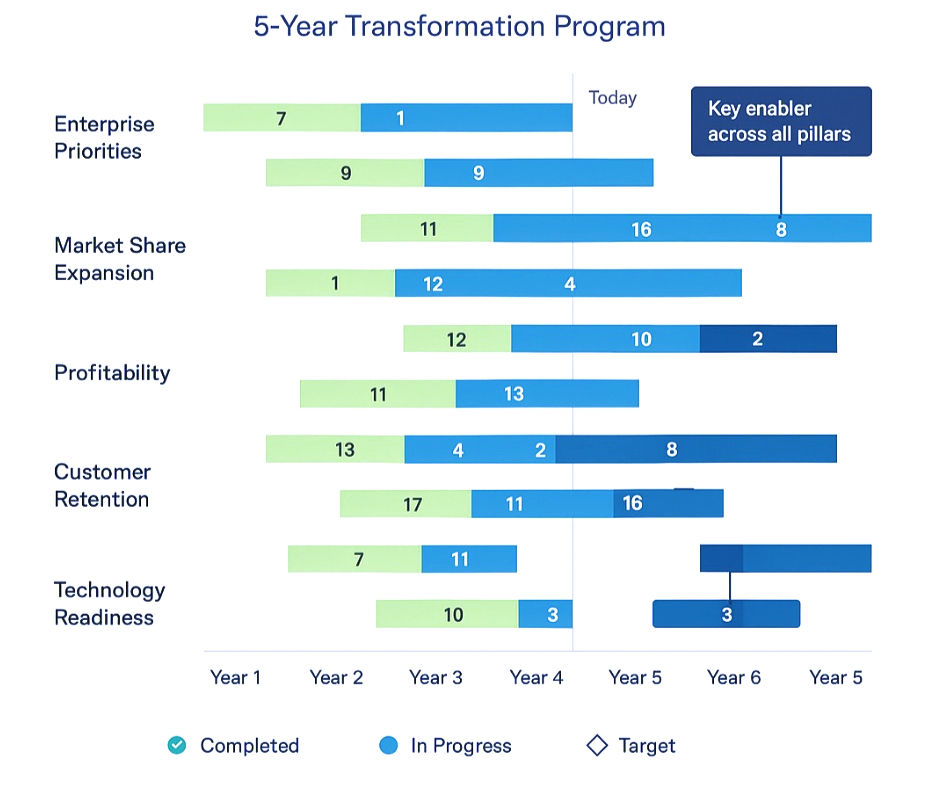
Tackling tariff uncertainty requires a structured approach. This project-style roadmap illustrates how companies can sequence actions – from assessing immediate buffers to longer-term restructuring. For example, steps may include inventory and supplier reviews now, followed by diversification initiatives and capital reallocation in upcoming quarters. Such visual frameworks help CEOs track tariff-related initiatives across functions and timelines.
Tariff Shocks and Nordic Exposure
In late 2024 and early 2025, trade policy took an abrupt turn. The U.S. introduced sweeping new tariffs – a blanket 25% levy on imported steel and aluminium and fresh duties on a broad range of Chinese goods – catching many companies off guard. Simultaneously, debate is heating up in Europe over possible retaliatory measures. These moves come against a backdrop of slowing global growth (forecast under 3%), which will cut demand for goods from the export-oriented Nordic economies.
The result is broad uncertainty. Many Nordic firms are now caught between shifting tariff boundaries: those with operations or suppliers in the U.S. may face American levies on parts once tariff-free, while those exporting to the U.S. see their competitiveness tested. Even companies not directly targeted feel pressure as costlier inputs flow through value chains. With rules changing rapidly, Nordic CEOs cannot afford to stay on autopilot.
Mapping the Challenge: Agility vs. Exposure
Positioning your organization within the interplay of tariff exposure and strategic agility reveals crucial differences in risk resilience. This matrix helps Nordic executives identify which archetype their firm aligns with—and what shifts are necessary to transition from reactive or static strategies toward adaptive, opportunity-driven positioning in a turbulent trade environment.A useful way to frame the challenge is by mapping companies along two dimensions:

Leaders can plot their companies in this framework to tailor responses: for example, an Adaptive Leader might double down on scenario planning, whereas a Watchful Waiter might prioritize shoring up core stability first.
Priorities for Nordic Leaders
One clear priority is building inventory and supplier buffers. With stockpiles running low after initial tariff announcements, the time to lock in longer-term arrangements is now. Companies should secure multiyear contracts with a diverse set of suppliers, invest in alternate production sites (such as within the EU or other low-tariff markets), and boost strategic inventory of critical inputs. Crucially, diversification does not mean swapping one dependence for another; it means creating an array of sourcing options so that no single disruption derails the chain. A dedicated cross-functional team (a “tariff task force”) can oversee these moves, balancing cost and flexibility to turn uncertainty into advantage.

A second priority is strengthening trade-compliance capabilities. The complexity of new tariffs, quotas, and rules means that customs expertise is a must-have. Firms that institutionalize a robust trade-compliance unit (combining skilled staff with analytics tools) will avoid fines and reroute shipments quickly when policies change. In practice, this might mean pre-classifying parts at risk of new duties or deploying software to flag high-risk components. In Scandinavia’s high-tech environment, companies can leverage advanced systems to anticipate tariff exposure and reroute shipments on the fly, maintaining agility when rules shift.
Another imperative is to embed rigorous scenario planning and pricing strategies. Leadership teams should map out the cascade of tariff impacts on costs and prices – for example, understanding that a 10% levy on steel can result in a much higher effective cost on finished goods if components cross multiple borders. Armed with these scenarios, companies can negotiate smarter. It is wise to include tariff-adjustment clauses in supply or sales contracts (or at least have pre-agreed fallback pricing) so that any new duty triggers a clear pre-negotiated response rather than a reactive scramble.

Nordic CEOs should also adapt capital allocation with agility. Rather than pausing all investment, redirect spending toward projects that build resilience. This might mean increasing funding for automation and local production capabilities, or boosting R&D in alternative materials and products less sensitive to trade barriers. Expanding into new markets (beyond the U.S.–China axis) and upgrading digital supply-chain tools can similarly hedge trade risk. Conversely, projects with heavy exposure to uncertain tariffs can be scaled back or deferred. The goal is to maintain momentum by funding agile, high-return initiatives while trimming or deferring the riskiest ventures.
About the Author

Felix W. Gliem
For nearly a decade, the Management Consultant and Headhunter in the role as Managing Partner at Friis+Borgesen, Nyborg Executive Consulting, has been assisting companies of all sizes to identify exceptional executives and specialists across various sectors, including Sales, Finacial & Banking, Engineering, IT, Technology, and Healthcare. With a particular focus on the Scandinavian market, we collaborate with innovative companies to develop talent and organizational strategies throughout Nordic Executive Search and Leadership Advisory.


Kommentare