
CEO & Board-Agenda 2025 - How Denmark’s OMXC25 Companies are preparing for Global Trade Volatility
- Insights

- 20. Apr. 2025
- 7 Min. Lesezeit
Danish industry Top-Executives and Boards are taking a proactive approach to global trade volatility. From shipping giants like Maersk and DSV to exporters in pharmaceuticals, biotech, and consumer goods, they're seeing it as an opportunity to innovate and grow.

In 2024–25, C25 companies are diversifying suppliers and markets, investing in digital supply-chain visibility, and infusing sustainability into resilience plans. Nearly every boardroom is now running scenario-stress tests for geopolitical shocks (tariffs, conflicts, climate events) and retraining management for agile decision-making.
Drawing on recent earnings calls, reports and expert surveys, we see a clear pattern: supply networks are being re‑figured (strategic near-shoring, multi-sourcing), technology dashboards and AI-powered planning are being fast-tracked, and leadership is upskilling in risk navigation.
The following sections highlight how these moves – from ESG-linked resilience strategies to data-driven scenario planning – are taking root in Denmark’s top companies, setting them up to weather uncertainty in 2025 and beyond.
Boards and executives are rewiring supply chains and strategies for an unpredictable 2025
Key Facts
Data-driven chains: 81% of companies with high-performing supply chains report robust internal data-sharing. Integrated visibility with partners is now seen as a resilience imperative.
Nearshoring surge: 76% of executives plan major supply-chain overhauls in the next two years. Most aim to “shore” operations closer to end markets (in Europe or regional hubs) to cut lead times and tariffs.
Digital investment: Roughly half of supply-chain organizations will invest in AI and advanced analytics in 2024. Leading firms are deploying advanced planning tools, IoT and AI to forecast disruptions and optimize inventory.
Concentration risk: Maersk notes China now accounts for ~36% of global container exports (up from 32% in 2019). Heavy reliance on a few trade corridors is a rising concern among Danish manufacturers and shippers.
Tariff pressures: With new tariffs looming, firms report accelerating imports and expanding storage buffers. Maersk warns that “volatile geopolitics cloud economic visibility,” reflecting concerns about trade wars and regulatory change.

Diversify and De-risk: Rethinking Supply Networks
Facing trade friction and disruptions, C25 firms are rewiring their supply chains. A leading consulting survey finds 81% of supply-chain leaders now “reorient their supply chains to be closer to customers,” a trend dubbed strategic shoring. In practice, this means Danish manufacturers and retailers are shifting critical sourcing and production to Europe or allied regions. For example, machinery and pharma firms are opening plants in Turkey or Eastern Europe; beverage and food companies are expanding European bottling; and energy equipment makers (like Vestas) are dual-sourcing components.
This diversification also extends to suppliers. Companies are seeking multiple vendors (often in different countries) for key parts to avoid single points of failure. Maersk notes that tariffs and geopolitical risks have already “cause[d] shifts in inventory strategies,” with some businesses moving to more localized stocking and near-sourcing. The goal is a more modular supply network that can reroute around any single disruption.

Boards are actively overseeing these changes. Boards of major exporters have added agenda items on geopolitical risk: e.g. discussing the impact of U.S. tariff policy or Red Sea shipping disruptions on logistics (as Maersk CEO Vincent Clerc has highlighted). Companies report using external risk monitors and scenario workshops to map out alternative trade routes and inventory strategies.
The takeaway: supply chains are being recast not for minimum cost but for built-in redundancy and flexibility. This may temporarily raise costs (as Maersk notes by rerouting ships via the Cape of Good Hope, adding two extra vessels per route), but firms see it as an insurance premium for continuity.

Digital Visibility and Smart Planning
Enhanced visibility is now a cornerstone of resilience. Danish CEOs emphasize breaking down silos: data from procurement, production, logistics and sales are being integrated so the whole organization “speaks one language” about supply risks. A recent survey (with Reuters) found 81% of top-performing companies have robust internal data-sharing; what truly differentiates them is extending that transparency to external partners. In response, C25 firms are deploying new tech: cloud-based supply-chain control towers, real-time tracking, and predictive analytics.
Cloud-based Supply-Chain Matrix

Digital roadmaps are accelerating. About 50% of companies plan major investments in AI and advanced analytics for their supply chains in 2024. Managers report pilots using machine learning to forecast parts shortages or to run “what-if” demand scenarios. For instance, one large industrial group is building AI models that simulate how a port closure or China lockdown would ripple through production schedules.
Others are automating order planning: using advanced S&OP (sales & operations planning) tools to replace error-prone spreadsheets. The idea is to shift from gut-based decisions to data-driven insights – so that even in a crisis (e.g., a sudden war or pandemic flare-up) they can quickly see the knock-on effects and adapt. The following framework is an effective visual tool for understanding the magnitude of the situation:
S&OP Sales & Operations Planning Framework

Crucially, this push requires new skills. Companies are retraining planners and executives in analytics and cross-functional collaboration. As Friis+Borgesen, Nyborg People and Organizational consulting firm advises, planning teams must “increase their skills in analytical modeling and cross-functional expertise” to leverage GenAI and other tools. Boards are also spotlighting digital literacy: at recent AGMs, several C25 chairs stressed the need to “digitally upskill the organization” so leaders can interpret dashboards and simulations.
Overall, the message is clear: digital transformation = resilience. Transparent, connected data flows allow supply chains to bend rather than break.
Embedding Sustainability into Resilience
For Danish companies, sustainability is no longer separate from risk management – the two are converging. Many C25 firms see climate and ESG goals as linked to supply-chain robustness. For example, Orsted and Vestas (renewables) naturally advocate for reducing carbon in the supply chain to avoid future carbon border taxes or energy disruptions. Carlsberg and other food firms are investing in water- and waste-reduction in their supply networks, partly because extreme weather (droughts, floods) is now seen as a business risk as much as a PR issue.
Regulatory pressures reinforce this focus. New EU rules (on deforestation-free products, carbon tariffs, etc.) mean companies must track origins and emissions across suppliers. Maersk warns that coming regulations “will push for greater visibility and compliance in supply chains”. In response, Danish exporters are mapping their multi-tier supply base (often down to raw-material sources) to ensure ESG compliance. This has a dual benefit: a greener supply chain tends to be more localized or circular, which inherently boosts resilience.
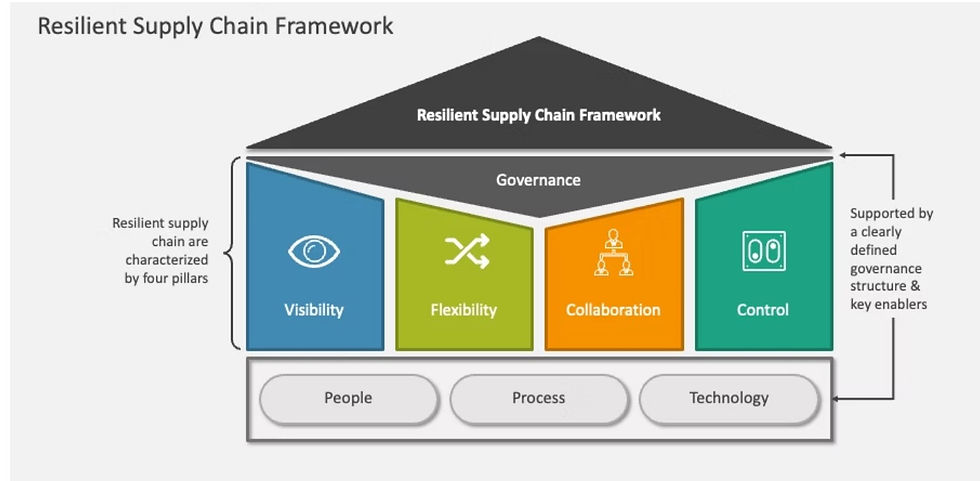
In practice, we see actions like: integrating sustainability criteria into supplier contracts; investing in renewable-powered logistics; and even using carbon pricing to stress-test project plans. Boards now routinely review climate risk scenarios; for instance, energy companies factor in extreme weather when siting facilities, and life-science firms conduct “climate-vetting” of critical suppliers.
In short, sustainability integration is treated as part of the resilience strategy: green practices reduce exposure to energy price shocks, policy changes, and social license risks, all of which affect long-term supply reliability.
By taking action now - with diversified networks, smart technology, sustainable practices, and vigilant governance - C25 companies aim not only to withstand 2025's turbulence but to turn it into competitive advantage.
Leadership and Governance for Uncertainty
Behind every operational move is boardroom intent. C25 boards have added “resilience planning” and “geopolitical risk” as standing agenda items.
Exhibition: 7 Steps for Scenario Planning Toolbar
Scenario planning tools bridge the gap between uncertainty and opportunity, enabling business leaders to map out possibilities, evaluate risks, and create actionable strategies.

Many use formal scenario planning processes: crafting narratives (e.g. US–China decoupling, Russia supply shocks, pandemic recurrence) and stress-testing the company’s strategy under each. This was once rare in Denmark outside of finance; today we find scenario workshops at industrial groups and quick-response war rooms in logistics firms.
Expert analyses confirm this leadership shift. Companies are urged to build “antifragile” organizations that improve through shocks.
Boards are pushing management to devise robust contingency plans (e.g. backup suppliers, safety stock policies, dual-shift factories) rather than just cutting costs. This requires new mindsets: as one advisor puts it, decision-making must become “performance-led” with clear metrics, and human expertise must fuse with data analytics.
Upskilling is underway. Firms report training executives in risk sensing and digital tools. Some have even rotated managers through “red team” exercises where they play out crisis scenarios. Another theme: strengthening collaboration across functions. In volatile times, silos can kill a company – so board directors are asking CFOs, COOs and CIOs to co-own resilience plans.
In a nutshell, leadership emphasis has broadened from purely financial targets to dual mandates: efficiency and resilience.
Danish CEOs and boards recognize that uncertainty isn’t just a temporary headache but a strategic reality to plan for
Key Takeaways
Rewire supply chains: C25 firms are diversifying and near-shoring critical flows, even at higher cost, to reduce single-region dependency. Strategic shoring and multi-sourcing are trending
Double down on data: Leaders are investing in supply-chain digitalization (AI, IoT, advanced planning) to gain real-time visibility. Integrated data drives faster, smarter decisions under stress.
Link green and risk: Sustainability efforts (renewable energy, carbon tracking, circular sourcing) are tightly coupled with resilience strategies. ESG compliance now also builds risk buffers.
Scenario mastery: Boards require comprehensive scenario planning and rapid response frameworks. Regular war-gaming of trade-conflict and climate scenarios is becoming standard.
Upskill leadership: Executives and board members are rapidly acquiring new skills (analytics, cross-functional coordination, crisis management). Cultivating an “antifragile” mindset is key.
About the Author

Felix W. Gliem
For nearly a decade, the Management Consultant and Headhunter in the role as Managing Partner at Friis+Borgesen, Nyborg Executive Consulting, has been assisting companies of all sizes to identify exceptional executives and specialists across various sectors, including Sales, Finacial & Banking, Engineering, IT, Technology, and Healthcare. With a particular focus on the Scandinavian market, we collaborate with innovative companies to develop talent and organizational strategies throughout Nordic Executive Search and Leadership Advisory.


Kommentare